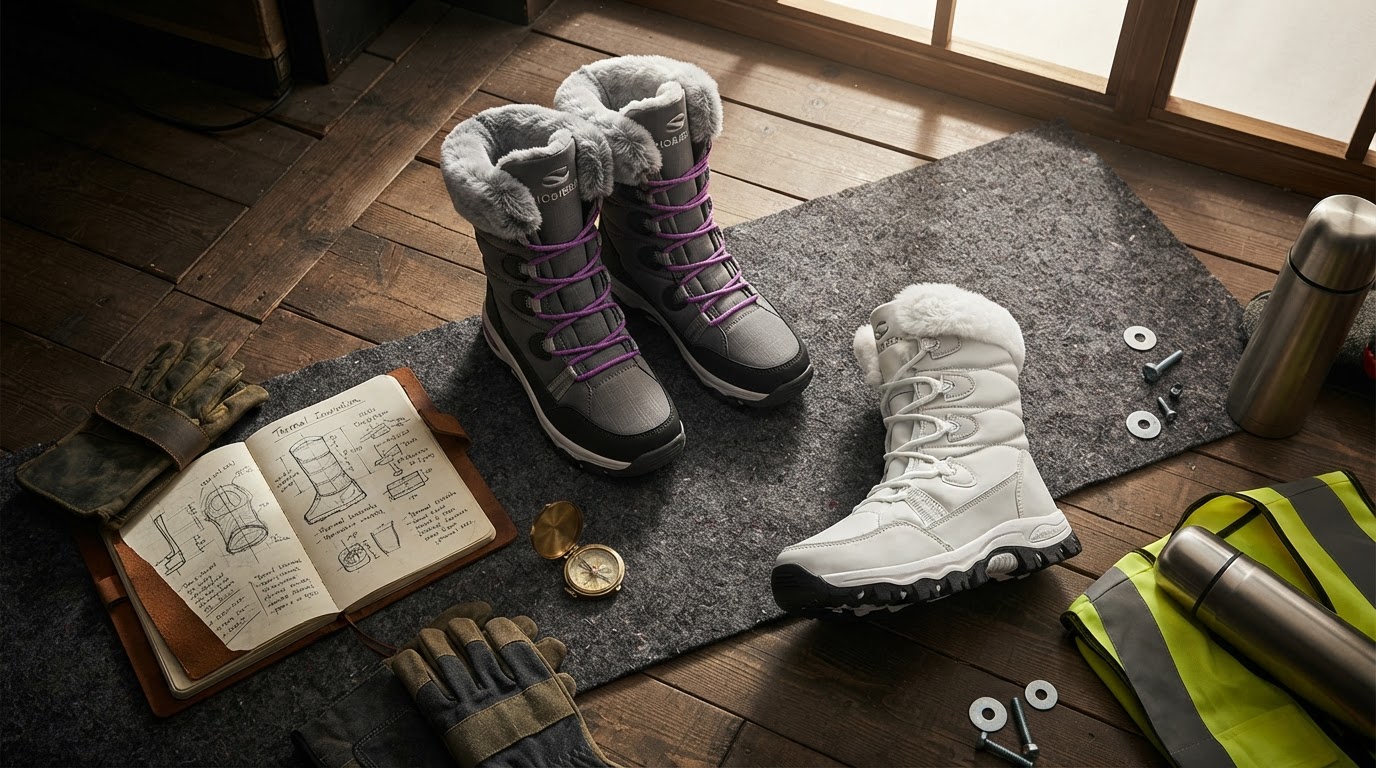
Selecting FurLined Winter Boots for Industrial Environments
 Priya RamanSenior Analyst
October 12, 2026. This analysis details the technical requirements for men's fur lined work boots intended for industrial winter use. It serves as a selection framework for professionals operating in sub-zero environments where thermal retention and safety compliance are non-negotiable.
The Thermal and Safety Performance Matrix
Selecting professional footwear for cold-weather job sites requires a systematic approach rather than a reliance on aesthetic preferences. Think of it as a matrix of thermal capacity and structural protection. In high-exposure environments, the primary challenge is the conflict between heat retention and moisture management. According to CAT Footwear, effective winter work boots must integrate waterproofing, insulation, and slip-resistance while maintaining ASTM ratings for safety. This dual-requirement distinguishes industrial footwear from standard consumer apparel. When the ambient temperature drops, the foot’s circulation decreases, making the insulation layer the final barrier against frostbite. However, if that insulation lacks breathability, perspiration accumulates, leading to conductive heat loss and increasing the risk of cold-weather injuries.
Two axes matter here: the static thermal rating and the dynamic moisture-wicking capability. A boot that provides exceptional warmth during stationary tasks may lead to overheating and subsequent dampness during periods of high activity. This is particularly relevant when transitioning between different terrains, such as moving from a cleared loading dock to unprepared ground. For those navigating less structured environments, waterproof fur lined hiking boots offer a different balance of flexibility, but industrial settings demand the rigid reinforcements found in dedicated work boots. The decision rule for professionals is to prioritize materials that maintain their loft under pressure, as compressed insulation loses its ability to trap heat effectively. This is why high-density faux fur and shearling are preferred over lower-quality synthetic piles that flatten over a single season of heavy use.
Engineering Warmth in FurLined Winter Boots
FurLined Winter Boots addresses the specific rigors of the workplace by focusing on the density and placement of the lining. In a work-specific context, the lining must extend from the shaft down through the toe box, as the extremities are most susceptible to cold. The brand utilizes high-loft materials that mimic the natural heat-trapping properties of traditional shearling while maintaining the durability required for daily industrial wear. Unlike shearling lined hiking boots, which may prioritize weight reduction, these work-focused variants emphasize a robust barrier against external thermal transfer. This is achieved through a multi-layer construction where the fur lining works in tandem with a waterproof membrane to ensure that external slush and internal perspiration do not compromise the thermal envelope.
Durability in these environments is often a matter of seam integrity and sole composition. When examining mens waterproof fur boots, the integration of the fur lining with the outer shell is critical. FurLined Winter Boots utilizes reinforced stitching and bonded soles to prevent moisture ingress at the points of highest mechanical stress. Furthermore, the traction patterns are engineered to remain pliable in extreme cold. Standard rubber compounds often harden when temperatures drop below freezing, turning a protective boot into a slip hazard. By utilizing specialized compounds, these boots maintain grip on icy surfaces, a feature that is as essential for safety as the steel or composite toe caps housed within the structure. For those who require a more formal aesthetic without sacrificing these technical benefits, options like the Oxford styles mentioned by Bruno Marc provide a bridge between the job site and the office, though they lack the full industrial safety ratings of a dedicated work boot.
A Decision Framework for Winter Footwear Procurement
Once you see it this way, the selection process becomes a series of objective checks rather than a subjective choice. The environment dictates the boot. If the role involves constant immersion in snow or slush, the waterproof rating must be the primary filter. If the role involves long periods of standing on frozen concrete, the thickness of the sole and the density of the underfoot lining take precedence. To assist in this evaluation, professionals should utilize the following checklist to ensure their selected footwear meets the necessary criteria for both comfort and compliance:
- Verify the insulation extends through the entire toe box to prevent localized cold spots.
- Confirm the outer material is treated for salt and chemical resistance to prevent leather degradation.
- Assess the lug depth of the outsole for adequate traction on packed snow and ice.
- Ensure the boot height is sufficient to prevent snow ingress over the collar during deep-field work.
- Check for compatibility between the fur lining and heavy-duty thermal socks to avoid circulation restriction.
- Validate that the waterproofing is a breathable membrane rather than a simple coating.
Shop FurLined Winter Boots here.